the frustrating predictability of romantic comedy [which feature] the idea that someone, often a woman, needs to learn a lesson in order to find love. Terminal disease seems like a particularly vindictive way to deliver that education. Dying of cancer isn't cute, it's not fun, and it's not kicky.
That post extends a similar theme she looked at before (briefly: a lot of TV shows feature women with trite complications, such as promiscuity or substance abuse, and call that psychological complexity), and both of them are part of one face of women in contemporary culture, which I've been thinking about lately, especially in terms of Jane Eyre and Mr. Rochester. Quick recap: a governess rises out of poverty and falls in love with her employer, a mercurial landowner, but can't marry him because of their class differences -- that is, until he becomes disfigured in a fire and she comes into a sudden inheritance.
The classically feminist reading of this relationship notes how Rochester has to be physically damaged before he and Jane are on sufficiently equal social standing to properly marry, and this relationship defines the contours of a lot of contemporary film and tv that center on professional women. Of course, for the modern tv girl, Rochester is abstracted (say, as a series of lovers) or internalized (the woman has some personality defect) that enables her to be successful at her jobs but terrible at managing her private life.
Abstracted or internalized, this new Rochester Effect is unavoidably moralistic, as if the makers of a given text feel that if a woman is going out into the workplace -- and what's more -- is succeeding there, then she deserves to be punished in her private or interior life to re-balance The Way Things Should Be. (It's sort of the Women in Refrigerators of tv/film, though, I suspect, not nearly as endemic as it is/was in comics.) Super-competent women like Temperance Brennan or Brenda Leigh Johnson have aspects of their characters that nearly debilitate them in social (or, in the case of The Closer, LA freeway) situations. I should further mention that in the case of Brennan, the Bones moral universe suggests that her current relationship status -- you know, the one where Booth has moved on -- is her of her own doing, and in fact, is an outgrowth of her fear of emotions and attachment. (On the other hand, as much as I disliked her, I kind of liked how (relatively) uncomplicated Fauxlivia was on Fringe, especially when she was on the Other Side. Interesting, though, that one of least psychically and socially damaged/fragile female characters I can think of is so squarely villainous, and is eventually maneuvered into submission to her emotions.) The Rochester Effect is pervasive enough that it's easy to see it everywhere (River Tam of Firefly, Echo on Dollhouse, Sydney Bristow on Alias, Patty Hewes in Damages, everyone on Battlestar Galactica) even when the characterizations are actually justifiably complex (as opposed to merely complicated). (Personal admission: I have not watched all episodes of all shows I've mentioned.)
An obvious retort is that male characters also have their psychological shortcomings, which are, in fact, necessary for dramatic tension or psychological depth -- House, for example. However, women and men don't come to tv or film with anywhere near the same baggage -- men have the benefit of not inhabiting gender politics, so to speak (we're the default -- hey high fives), whereas women in the media are far more inextricably bound up in gender politics, so it's harder to see the characterizations of women as innocent drama and psychology, even in the Golden Age of television.
Alyssa posted a gangbusters of an overview of Bones right before the fifth season premiere -- read it. For instance, her paragraph on the imperfections of the main characters is trenchant and something that I could never have articulated if somebody didn't point it out to me. (She's a lot more charitable about how Deirdre Lovejoy was used in her cameo appearance on the show, which I abhorred. I'll just say the role she was given was thankless and perfunctory, especially since Rhonda Pearlman is still so vivid in my mind.)
Funny thing is, I disagree with Alyssa's main argument -- that the plot inconsistencies might inevitably break the show, although I assume that's because of my personal blind spots. But, in the end, the show is for me less about the characters as people or even plot continuity (I mean, we saw how Zack's character was rewritten in the middle of the first season), but more about how Bones uses the procedural formula as the barest skeleton on which to hang snappy relationships, cartoonish grossouts, silly one-liners, admiration for empiricism, and last but not least Brennan's disdain for psychology (I'll never tire of her calling it a "soft science" -- never). All of these qualities are awfully elastic and can bear the weight of a lot of the show's let's call it idiosyncratic storytelling impulses.
All that said, "Harbingers in the Fountain" recovered from last season's finale (and really, season 4 was mostly unremarkable), thankfully avoiding the tedious post-amnesia cliches and instead (potentially) setting up an interesting way of examining self and identity. And as contemptuous as I am about televised shipping, my unfeeling heart was tugged into empathy at the love that dare not speak its name (if queer theory people will forgive the appropriation) between Booth and Brennan -- they're on the cusp of domestic bliss, and the cusp is always more rewarding when we're talking about tv.
But Cyndi Lauper's tarot reading skills were still pretty dire.
Almost as a rule of the genre, procedurals often mine topical events or subjects for stories (that is, when they're not ripping their stories from headlines -- I'm looking at you, Law & Orders). And since Bones already has a reputation as a procedural that's also lighthearted, I wouldn't expect it offer as delicate and moving a story as "The He in the She." What jumps out most of this episode is its subject matter -- a post-op trans pastor, who, of course, has been murdered -- but the episode actually transcends matters of biology and approaches something much more spiritual. In fact, Sweets cuts to the chase: "The term 'trans' conveys a meaning of 'beyond the cross,' moving further. There's a very spiritual component," and in the worldview of this episode, the spiritual component -- not the physical body -- lies at the core of human essence. Which is where the church angle enters the discussion, and where "The He in the She" closes: a congregation of "gay and straight, black and white, fat and thin, man and woman, saint and sinner," as preached by Ryan Stephenson, the prodigal son who sought redemption among the fallen (e.g. the addicts at a detox center) to find redemption at his father's Inclusion Church, which was entirely composed of people from society's margins. Thus borne out of familiarity with the Other, arises a utopic vision of religion at its most hopeful, its most all-embracing.
Indie rating: Antony and the Johnsons - "My Lady Story"
First a desultory top 10 8 albums of the year, though with a nota bene: I don't think I've been this disinterested in putting together a year-end list in recent memory. That doesn't have anything to do with the quality of the year's releases; rather, my media priorities and critical attention have shifted unequivocally towards teevee, and I haven't felt the urge to keep up my indie cred as years past. This list makes no claims as to comprehensiveness:
* The Electrelane ménage -- krautrock and gorgeous melodies -- hooks up with sweet, heartbroken lyrics. Much rejoicing. (Come back, Electrelane! -ed.)
≈ An ambient record you have to listen to, spacious and intimate. The key is to disappear into the waves...
† Never heard anything so loud.
℘ Nothing wrong with Peej doing pretty, especially as a Civil War ghost.
∞ Baltharian reveries on the Cylon baseships.
1234 Geddit?
∪ Cheating, sure (i.e. Pink live!), but I finally get Merzbow now, he just needs to play behind a hardcore punk-metal trio shredding out the best post-Motörhead long-player ever. (Nb. the linked video isn't with Merzbow -- you'll just have to imagine the track with more industrial noise.)
∫ The most pummeling quiet record -- ever?
Enough of the music bollocks, here's the TV
If you're a regular reader, you probably have picked up my contrarian views which, I'll admit, are sometimes (oftentimes?) blatant provocations, playing the devil's advocate just for its own sake. And one of the unstated assumptions that underlies this blog (and explains the amount of energy I put into it) is that tv land always has quality, it's not the underachieving wasteland that various cultural sentinels would have you believe it is. Critics who complain about any given year's quality are these dour sentinels, or else they're deluged by the sheer volume of mediocrity that's unavoidable in any medium, and I have little time for their opinions.
That said, I compiled the 10 Best Hours of 2007 with difficulty, though to avoid historical revisionism, I had a hard time doing it last year, too. Part of the reason is that the new shows mostly disappointed (though I swear to God, Reaper delivered on its promise), while the old favorites either stumbled along during Fall 2007 (which piled additional detritus onto the sublimity of Spring 2007 that I had to mentally sort through) (also, the strike didn't help, but we'll probably never know just what could have been if things had been business as usual), or skipped this year altogether, whether by HBO's strategized scheduling practices (you guessed it, The Wire) or because their runs simply ended (Teen Titans, Justice League Unlimited).
And sometimes I'm just behind the curve. Just this year, I've caught up (and I'm still catching up) on no fewer than 5 shows of which I'm now an entrenched fan, and no doubt I'll still be discovering new shows. But for the moment, if I could propose an amended 10 hours from 2006, they'd look something like this (new entrants bolded):
10. Justice League Unlimited, "The Great Brain Robbery" (5x08) 9. Friday Night Lights, "Pilot" (1x01) 8. Survivor: Cook Islands, "People That You Like Want To See You Suffer" (13x10) 7. Heroes, "Fallout" (1x11) 6. Teen Titans, "Things Change" (5x13) 5. Lost, "Live Together, Die Alone" (2x23) 4. Veronica Mars, "Not Pictured" (2x22) 3. Battlestar Galactica, "Resurrection Ship, Part 2" (2x11) 2. America's Next Top Model Cycle 6, "The Girl Who is Going to the Moon" (6x09) 1. The Wire, "Final Grades" (4x13)
Given that almost half of my top 10 of 2006 got turned over, anything I put together for 2007 is destined to be no less temporary. (And let's not forget that we're talking about tv here, that gloriously ephemeral and intangible medium -- at least it was before the DVD, which, like the edenic serpent, introduced to it the death of permanence and respectability, but that's another matter).
But the real reason a list of 10 was hard this year and probably will always be hard is that for all the tv I watch, I don't watch enough to compile awesome episodes from 10 different shows, which is sort of reflected in my year-end music list as well. I don't have enough time to watch that much tv, I don't have cable, I'm afraid of getting hooked on shameless trash (like, say, The OC), I don't believe in the concept of a canon -- whatever combination of these reasons is the case, I don't come close to comprehensiveness, and so if you ever read me saying "this year was a bad year in tv," feel free to launch a projectile of your choice (I suggest: a football) towards my groin.
Which is all to say that the following list is a project of simple vanity. Just because I include certain shows on an arbitrary list doesn't make them more legitimate or better than anything anyone else watches (even if I make claims to the contrary -- remember, I'm an admitted hypocrite). In addition to the vanity, a top 10 lets me reflect on some shows, to work through why I enjoyed them, with perhaps a dash of evangelism for the more ratings-challenged ones.
Finally, I should state that despite the anti-canon equivocations of the preceding paragraphs, the top five includes episodes that sent me into ecstasy -- whether of the unadulterated variety or the kind that involves endorphin-releasing schadenfreude -- enough so that 2007 was a great tv year, however you slice it.
(Nb. I realize that one of the entrants below is actually two hours, but for the sake of symmetry, shut up.)
10. So You Think You Can Dance, Week 1, Top 20 Dancers Perform (3x06; FOX, 6/13/07) The overall talent level, if not the choreography, was exponentially better than years past, and all the promise offered by the dancers was nearly as exciting as anything they actually did. Also, this was kinda hot, and a certain host put the "cat" into "lolcat."
9. Project Runway Canada, "Opposites Attract" (1x06; Slice, 11/12/07) Just as you'd expect, the Canuck version of Runway doesn't have the same bite as its southern cousin since, as we all know, Canadians are scientifically more polite than Yankees, which, when it comes to reality tv, is to sadly blander effect. (I can make this un-PC generalization because I watched an episode -- one whole episode! -- of Canada's Next Top Model.) For instance, Evan Biddell, the show's self-styled heavy, slimmed down from his pre-Runway weight of 300 pounds, then bit off the catchphrase of an infinitely more colorful American Runway contestant. Some heavy!
Yet, the most notable trump card that Runway Maple Leaf holds over Runway Crying Eagle is its host, Iman. While Runway Canada kicked off with as much empty space and personality as the Northwest Territories, Mrs. David Bowie single-handedly raised her version above any stereotypical and expected Canadian blandness. Iman owns the whole show in a way that Heidi -- bless her always-smiling Teutonic femmebotness -- never has. Iman informed the designers of their upcoming challenges and all eyes were of course on her. Her hosting style was uncompromising as she takes her sweet time with her line readings. Where Heidi bids farewell to eliminated contestants with the impersonal "auf Wiedersehen," Iman tells them what's up, "You just didn't measure up." But it was in the sixth episode of the season that she at last decided to utterly dominate the show, letting loose with charisma, humor, and an effortless strength of opinion that is captivating.
In fact, she almost single-handedly raised the show's game at the opening of the show when she reminded everyone that she can still bring the woah:
I haven't seen someone work the shadows like this since Sydney Bristow. It's safe to say that she'll always be an elegant lady.
She also combines my two favorite things: glasses, and white girls.
8. Bones, "Mummy in the Maze" (3x05; FOX, 10/30/07) Even if I never remember the procedural bits, Temperance Brennan makes science and empiricism sexy.
7. John From Cincinnati, "His Visit: Day Five" (1x06; HBO, 7/15/07) The most thrillingly weird moment on TV since the first season finale of Twin Peaks. Prepare yourselves.
Sure, this scene is pure spectacle that pointed to mythological depths at the time but instead opened up a can of worms that ultimately turned out bottomless -- but sometimes payoff is unnecessary. Some things just can't be expressed yet remain beautiful all the same. If you can let yourself be enticed by the unanswerable mystery, the unfettered unknowable, and unbounded possibility, then you'll have stumbled onto the allure of the ineffable. It's a vastness which, if I were the grandiloquent type, I'd call God. (Also if I were a blasphemer.)
Oh, and who can forget this sparkling performance? Camp (albeit unintentional) and weirdness -- John From Cincinnati really is the Twin Peaks for the '00s.
6. Reaper, "The Cop" (1x08; The CW, 11/13/07) Remember how I'm never wrong? Still the best new show of the season. Yes, a lot of Reaper's own viewers have cited the show's uneven tone or its meandering master narrative, but I could barely care less and I'm still not wrong. Look, if I acknowledge every one of my mistakes, that'd make for exceedingly dull reading. Like our own beloved president, never admit to error! So here's how I reason my way out of this quandary: for me, nearly any narrative deficiency can be compensated for by hilarious wit, especially the sophomoric variety, which Reaper has no problem with. As a for instance, peep this. (Start at about 8:30.)
5. Survivor: Fiji, "It's a Turtle!" (14x10; CBS, 4/19/07) In Fiji, the lines drawn in the sand split the would-be survivors into two principle camps: the players I adored -- Yau-Man and Earl -- and the players I hated -- Alex and Mookie, who liked to figuratively flex their muscles and kick sand in the face of slight professor Yau-Man. (There was a third camp, the people I couldn't care less about, but that describes exactly how much energy I want to spend on them.) Alex was a piece of work inside and outside the game, but I loathed Mookie, whose defining moment came two episodes earlier, during a projectiles-throwing challenge, when he ridiculed Yau-Man's unorthodox technique which, of course, had the weight of science behind it as he pwned Mookie (start at about 2:30 for the goods -- don't miss his shock and dismay that a skinny old dude could manage to outperform him). That instant crystallized the jockish presumption that typified Alex and Mookie, and when they thuggishly tried to strategize against Yau-Man and Earl and dubbed themselves (along with Dreamz and Edgardo) something as junior-high pimply as "the Four Horsemen" (of what? Delusionally Inflated Ego and Pathetic Macho Dick-Swinging?), their plans obviously and completely unraveled with the frothiest layer of schadenfreude ever on Survivor. The bad guys don't always get their comeuppance in reality tv -- much less reality qua reality -- but when it does, there's nothing sweeter.
Also, Boo's FLOZ hat is destined to be the enduring mystery of our times.
4. Friday Night Lights, "Mud Bowl" (1x20; NBC, 3/28/07) Season two has made me reconsider the fabled first season's naturalism, which is more accurately Naturalism since the situations so often were larger than life and their consequent outcomes concluded neatly by preternatural maturity (which season two tried to complicate by rolling back and/or conveniently forgetting a lot of character growth). But scratch the substance and you reach the show's real meat, its style. Don't let the vérité influences and flourishes fool you, because they're precisely the point, and did "Mud Bowl" ever bring the ruckus: Of course Dillon was going to win its regular season finale to go on to the State Championship, which would've been predictable and lifeless if the moment was anything less than heart-stopping and epic. A neutral site built days before the game. A torrential storm torn straight from YHWH's Old Testament wrath. Motherfucking Isis. Boys entering the crucible of flooded ash and the annihilation of all ego, and emerging men of character. And a television show transcending the shackles of substance and into the realm of pure aesthetics.
3. Heroes, ".07%" (1x19; NBC, 4/23/07) Wherein Nate loses out on Linderman's pot pie, and the show's nerd quotient goes through the roof. I never plotzed so much.
2. 30 Rock, "Greenzo"/"Somebody to Love" (2x05, 2x06; NBC, 11/8/07, 11/15/07) See what I did there? Together, not only were these two episodes the most riotous consecutive weeks in sitcom history (not even God, if She were a divine comedy Supercomputer with all eternity to write half-hour laff-fests, could come close to the hilarity), but they also add up to one hour! I'm smart, like Al Gore.
1. Veronica Mars, "The Bitch is Back" (3x20; The CW, 5/22/07) Loathe as I am to admit it, the fans were partly right, the third season was the least of the three. Yet for all the foul cries and spurned oaths, Veronica Mars was never a categorically bad show. Season three shifted its method; instead of one grand mystery, the season was split into three abbreviated mystery arcs (though in the end, that last arc got chopped even further into mostly standalone episodes so the CW could look for Pussycat Dolls), and as a result, the show's scope and focus consequently suffered. Not much, mind, but enough to throw fan nation into a frothy spaz.
Yet all that was erased when Veronica Mars and her father Keith became mired in a sex tape and election scandal in the Veronica Mars episode ever. Their fates were never so much in doubt, and the show was never so uncompromisingly urgent, its status quo never so ruthlessly overturned -- all of which would have still applied even if the season finale hadn't officially become the de facto series finale. Leaving the Marses -- heretofore the most self-sufficient and self-composed father-daughter duo ever to grace network tv, I'd gather -- dangling over this network show's most dangerous and uncompromising knife-edge (a show which, on a regular basis, dealt frankly with teen sex, teen drug use, and teen angst) to no resolution was as cruel of a kick in the teeth as the agony that Keith and Veronica suffered.
Just a warning: Next year, if you're still reading and I'm still blogging, expect to see an all-Wire top 10.
When Vladimir Nabokov fled Russia for western Europe and later the US, one of the ways he supported himself was to write chess problems, of which he held a decidedly idiosyncratic procedural view. His chess problems were contrived to have elaborately convoluted solutions, but if you hated fun, they could also be solved through blandly pedestrian moves. The pleasure of his puzzles didn't come from the mating black's king; rather, pleasure derives from the convolutions and vicissitudes of the solution's process.
And if I've learned anything about Bones having watched about 14 episodes, it's that the whodunit hardly matters in the grand scope of the show or in terms of its appeal, which this latest episode aptly demonstrates. At the show's outset, when Gil Bates (obviously a spoonerism for Bill Gates, and I have to say, the name of a character in one of my stories) exclaimed to Brennan and Booth his shock at the body in the capsule because he was the one who sealed it, he should have been the first person investigated as a suspect. Instead, the episode proceeded on a circuitous path, the investigative details of which merely provide the backdrop for Booth and Brennan's repartee.
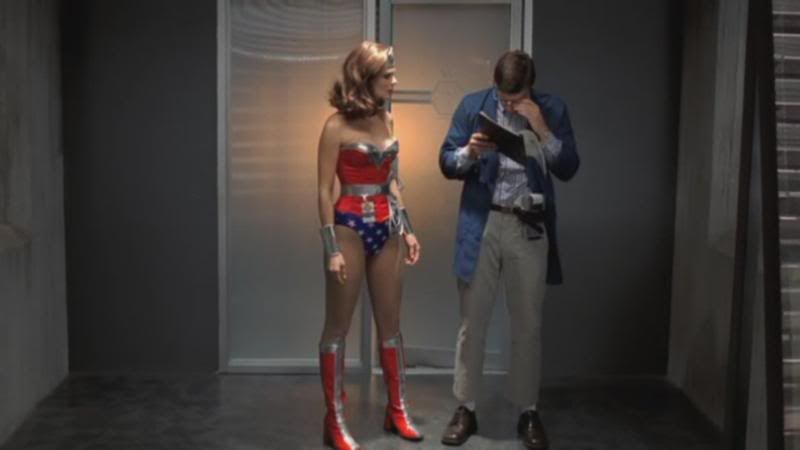
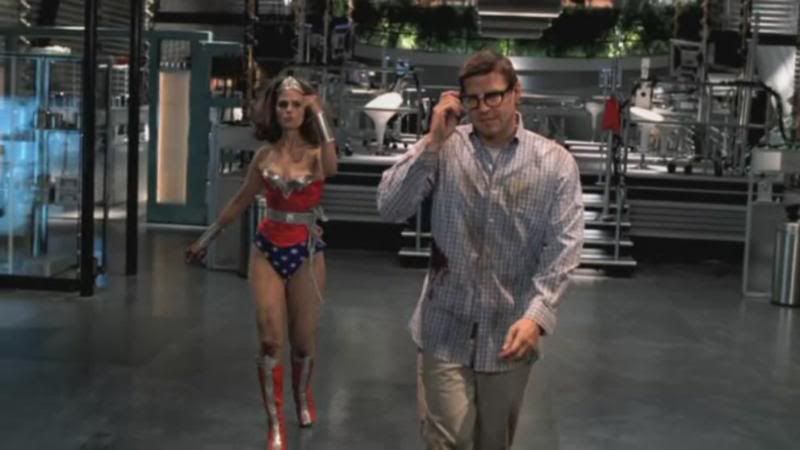
Tuesday night at 8 PM was rather a notable occasion for the Bay Area -- a Halloween-themed episode of Bones that promised Emily Deschanel dressed up as Wonder Woman, which should be more than enough to entice anyone to watch the show, you ask me. But leaving aside the eye candy, Bones is above all a crime procedural whose meat and potatoes isn't the crime and its resolution and instead is the interplay between Dr. Brenner (Deschanel) and Agent Booth (David Boreanaz), which is, as episodic post-CSI procedurals go, kind of revolutionary. I'm sure this revelation isn't news to people who've watched Bones longer, but I realized it most palpably with this week's episode, during which a few other things happened underfoot.
The Alum Rock quake was considerate enough to hit either during the title credits or the first commercial break (8:04, officially), so I didn't miss any of the show (no damage Chez Meee, by the way). Unfortunately, local anchor Julie Haener, lovely as she is, was nowhere near as discreet, interrupting the show later with two emergency news breaks -- so by the time that Bones and Booth found out that the culprit this week was the EMT, I was all, "What EMT?" which underscore that plot is a secondary vehicle to drive the hijinks between the various couples.
I couldn't follow the arc of the plot, but that wasn't a big deal; the comic banter between Bones and Booth, and the rest of the cast too, was lively, capped by Bones pantomiming the Lynda Carter-era Wonder Woman spinning and deflecting imaginary bullets, which was cute beyond words.
While the rapport between Brennan and Booth belongs to the grand tradition of opposites-attracting couples, I doubt that Moonlighting, Cheers, or The X-Files ever gave such a precise voice in the name of science. (OK, maybe The X-Files, but it was grounded in the supernatural/extraterrestrial as much as it was in science.) I find the lengthy monologues on diatomaceous earth and odes to adipocere formations (not that I understand them) endlessly fascinating -- and as a burned out ex-academic, I love the show's "psychology is a soft science" jabs. (Speaking of which, straight out of the Ok... WAHT??? file, Sam Weir from Freaks & Geeks has gone through puberty (!) to become the show's recurring psychiatrist.) As much as it is a procedural with great chemistry, deep down, Bones is a valentine to the scientific method and empiricism.
Indie rating: Peter Wright - "Heteralocha Acutirostris"